







In many industrial settings, connector heating is a common yet often overlooked issue. However, long-term abnormal temperature rise is a very dangerous signal. Temperature rise control in high-current industrial connectors is essentially part of system reliability design. Selection should not only focus on rated current but must consider four dimensions: contact resistance, conductor material, locking structure, and derating. This article starts from the root causes of excessive temperature rise and outlines four key selection methods for reducing heat and temperature rise in high-current industrial connectors.
1. Why Do High-Current Connectors Overheat? What Causes Excessive Temperature Rise?
When high-current industrial connectors transmit electrical energy, current flowing through contact resistance generates heat, causing the temperature to rise. The temperature rise of a connector comes from three main contributors: Joule heat from contact resistance + Joule heat from conductor resistance + ambient temperature. Among these, contact resistance is the primary source of heat.
When contact resistance is too high, localized heating intensifies, accelerating spring stress relaxation. Reduced contact force further increases contact resistance, creating a vicious cycle of "increased resistance → more heat → stress relaxation → further resistance increase," ultimately leading to failure. Excessive temperature rise is a fatal flaw for high-current industrial connectors — prolonged exposure can cause insulation degradation, premature product retirement, and even fire hazards.
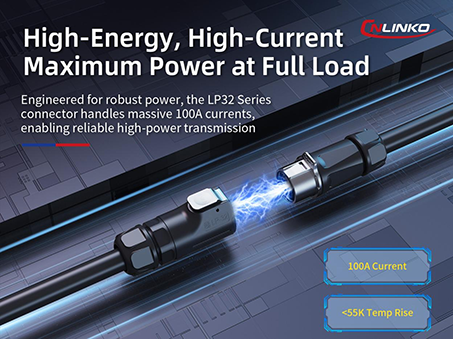
What is the acceptable range for temperature rise? Generally, it must comply with relevant standards. For example, under rated current, the temperature rise of high-current industrial connectors should be strictly controlled within a reasonable range to ensure safety and performance.For example, the temperature rise of CNLINKO's DL28 series power connectors is ≤50K, and that of the LP32 series is ≤55K. Both comply with standard requirements, ensuring safer long-term use.
2. Four Key Selection Methods to Reduce Heating and Temperature Rise in High-Current Connectors
Method 1: Prioritize Contact Materials and Platings with Low Contact Resistance
Contact resistance is the "culprit" behind temperature rise. When selecting, pay close attention to the contact material and plating process.
Material: Use copper alloys with high electrical conductivity for pins and sockets to significantly reduce resistance and heat generation. High-quality copper alloys perform far better than ordinary brass.
Plating: Contacts in high-current industrial connectors are typically gold-plated or silver-plated. Large-diameter pins often use silver plating. Plating quality must focus on thickness uniformity — uneven plating can lead to localized overheating or arc breakdown. A combination of high-quality copper alloy and silver-plated contacts effectively reduces contact resistance and temperature rise.
Method 2: Choose Products with Optimized Contact Structures for Multi-Point Contact
Single-point contact easily leads to localized overheating. High-quality high-current industrial connectors use multi-point contact designs to distribute current evenly, resulting in more uniform temperature distribution. A design combining rigid pins with slotted sockets can effectively reduce the risk of localized overheating in industrial applications.
Method 3: Pay Attention to Locking Structure to Prevent Vibration-Induced Contact Resistance Surge
Vibration environments accelerate the increase of contact resistance. When a connector experiences micro-movement due to vibration, contact pressure drops, contact resistance rises, and heating worsens. When selecting, prioritize high-current industrial connectors with dual-locking structures.
For example, CNLINKO's DL28 series high-current connectors adopt a "screw bayonet + anti-back-off outer ring" dual-locking design. Through male-female engagement and radial secondary locking, they effectively suppress micro-motion of contacts caused by high-frequency vibration, controlling abnormal increases in contact resistance at the source.
Method 4: Derate Based on Actual Operating Conditions and Reserve Safety Margins
Rated current ≠ usable current. The rated current of a connector is typically measured at 20–30°C, with single-terminal energization, standard wire gauge, and natural convection. When multiple terminals are used side by side, ambient temperature rises, or the connector is inside a sealed enclosure, the rated current must be derated.
Selection rule of thumb: The long-term operating current of equipment should not exceed 70%–80% of the rated current of the high-current industrial connector. In sealed enclosures, ambient temperatures ≥60°C, or near heat sources, the rated current must be derated by 20%–40%. Always request the supplier to provide a "current-temperature rise-adjacent terminal count" curve during selection.

Conclusion
Selecting a high-current industrial connector is fundamentally about temperature rise control — contact resistance, conductor material, contact structure, locking design, and derating are all indispensable. Choosing based solely on rated current while ignoring temperature rise will inevitably lead to problems once the equipment is installed in the field.
As a national-level specialized and new "Little Giant" enterprise, CNLINKO offers multiple series and models of high-current industrial connectors, such as the DL28 series power connector and LP32 series power connector. All feature high-conductivity silver-plated copper alloy contacts, multi-point contact structures, and dual-locking designs, covering full-scenario needs from 50A compact power distribution to 100A ultra-high-power transmission.