







In industrial automation, robotics, new energy equipment, outdoor lighting, and many other scenarios, circular industrial connectors are almost everywhere. Thanks to the natural strength advantage of their cylindrical structure, they excel in vibration resistance, waterproofing, and impact resistance. However, most people's understanding of industrial connectors stops at "plug it in and it works"—they rarely know what components make up the connector or what function each part serves.
Understanding the structural composition of a circular industrial connector not only helps engineers make more precise decisions during selection but also enables faster troubleshooting when equipment fails. This article breaks down the four core structural components of a circular industrial connector.
I. Contact Elements: The "Heart" of the Industrial Connector
Contact elements are the core parts that enable the electrical connection function of a circular industrial connector. They establish an electrical path between the plug and socket for power, signal, or data transmission.
Contact elements generally consist of a male contact (pin) and a female contact (socket) forming a contact pair. Male contacts are typically rigid parts with shapes such as cylindrical (round pin), square (square pin), or flat (blade), and are usually made of copper alloy. Female contacts, or sockets, are the critical component in the contact pair—they rely on an elastic structure that deforms elastically when mated with the pin to create tight contact. Socket structures come in various types, including cylindrical (slotted, crimped), tuning fork, cantilever beam, box type, and hyperboloid wire spring sockets.
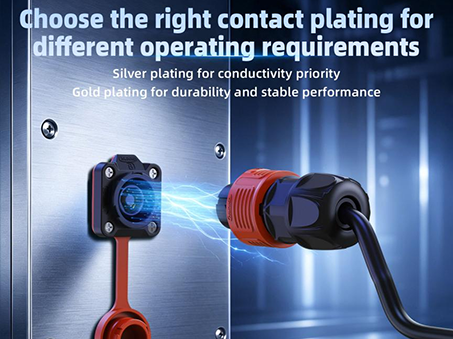
The material and plating process of contact elements directly determine electrical performance. High-quality copper alloys combined with gold, silver, or nickel plating effectively reduce contact resistance and improve oxidation and wear resistance. For example, CNLINKO's LP series circular industrial connectors use gold-plated copper alloy contacts with low impedance and temperature rise controlled within 30K; the BD series circular connectors also feature gold-plated contacts with outstanding corrosion and wear resistance.
II. Insulator: The "Skeleton" for Fixing and Isolation
The insulator, also called the base or mounting plate, is the main structural component of a circular industrial connector. It has two core functions: first, to position and secure the contact elements at the required locations and spacing; second, to provide electrical insulation between contact elements and between contacts and the housing to prevent short circuits.
The choice of insulator material directly affects the connector's insulation performance and dimensional stability. Commonly used insulating materials include high-performance plastics such as PBT, PA66, and LCP. Good insulation resistance, voltage withstand capability, and ease of processing are basic requirements for selecting insulating materials. In CNLINKO's LP series industrial connectors, the housing uses high-grade PBT engineering plastic, combining insulation performance with corrosion resistance.
III. Housing: The "Armor" for Mechanical Protection
The housing is the outer shell of a circular industrial connector, providing mechanical protection for the internal insulator and contact elements. It also provides alignment when mating the plug and socket and secures the connector to the equipment.
Housing materials are typically divided into metal and engineering plastic types. Metal housings (aluminum alloy, stainless steel, brass, etc.) offer higher mechanical strength and electromagnetic shielding performance; engineering plastic housings (such as PBT, PA66) are lighter and more corrosion-resistant. CNLINKO's LP series circular industrial connectors offer multiple housing material options including metal, plastic, and semi-metal/semi-plastic designs; the YM series circular industrial connectors feature an all-plastic housing design for lightweight construction and excellent corrosion resistance.
IV. Accessories: The "Details" That Ensure Reliable Connection
Beyond the three core components mentioned above, circular industrial connectors also include various accessories, categorized into structural accessories and mounting accessories. Structural accessories include retaining rings, positioning keys, positioning pins, guide pins, coupling rings, cable clamps, sealing rings, and sealing gaskets. Mounting accessories include screws, nuts, studs, and spring washers.
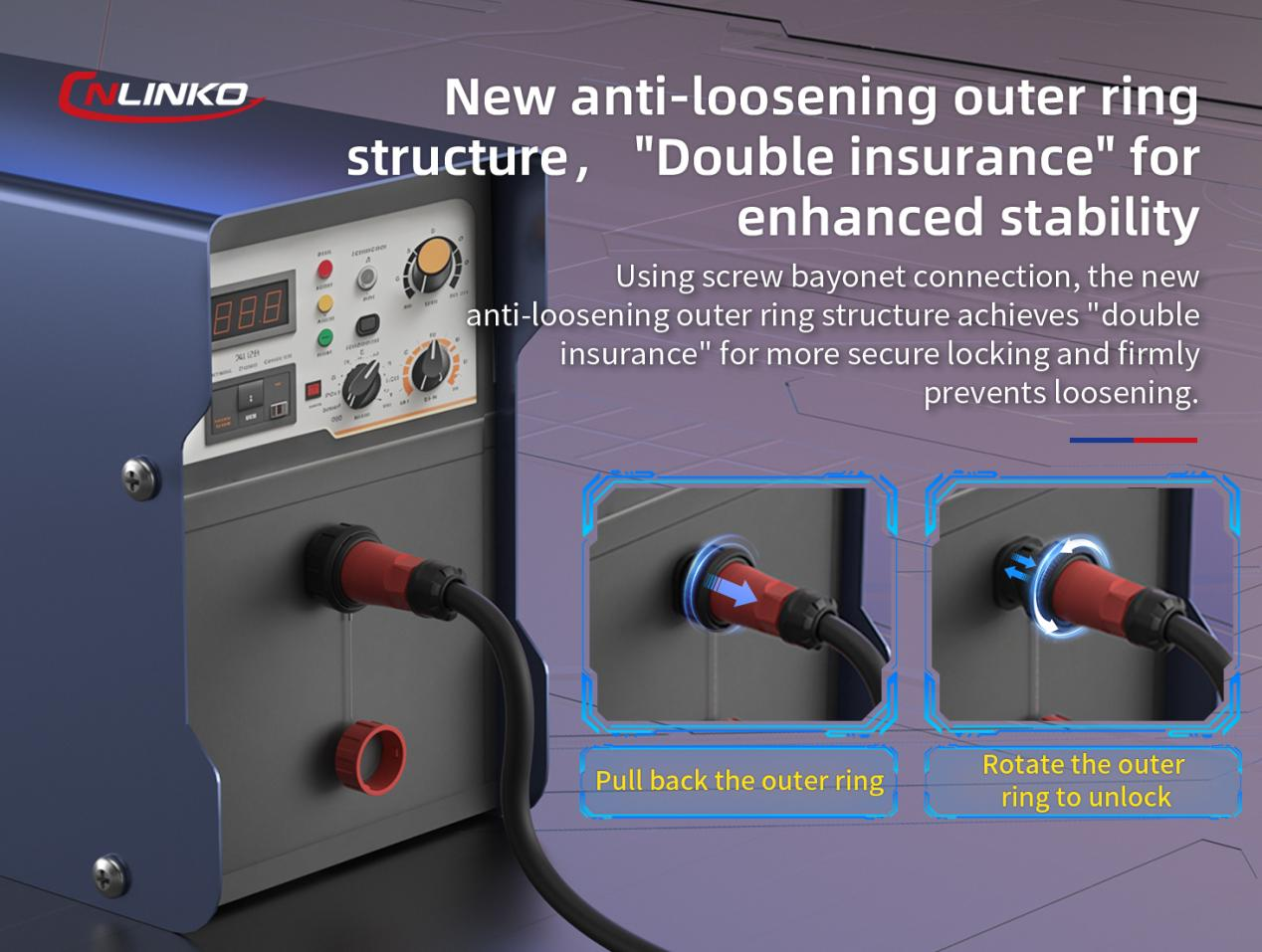
Among these, the locking mechanism and sealing ring are two particularly critical accessories. The locking mechanism secures the male and female ends together to prevent loosening due to vibration—common locking methods include threaded locking, bayonet coupling, push-pull, and snap-in quick-lock. CNLINKO's YM series and DH series circular industrial connectors use a spiral bayonet design, offering excellent anti-loosening capability under strong vibration conditions; the LP series and BD series circular connectors feature a push-button straight-plug structure for one-handed operation; the DL28 series adopts a dual-lock structure combining "spiral bayonet + anti-rotation outer ring." The sealing ring provides waterproof and dustproof capability and is key to achieving high protection ratings such as IP67 and IP68. Multiple series of CNLINKO circular connector products achieve IP68 (immersion-proof) and IPX9K (high-temperature, high-pressure water jet-proof) protection ratings.
Though small in size, circular industrial connectors have a rather sophisticated structural design—contact elements handle electrical conduction, insulators ensure electrical isolation, housings provide mechanical protection, and accessories guarantee reliable connection and environmental tolerance. It is the coordinated work of these four parts that allows industrial connectors to operate stably over the long term in harsh industrial environments involving vibration, moisture, and corrosion.
As a national-level specialized and innovative "Little Giant" enterprise, CNLINKO has deployed multiple product lines in the circular industrial connector field, including the LP series, BD series, YM series, DH series, DL28 series, and DK24 series, covering all connection needs for power, signal, and data. These products are widely used in industrial automation, robotics, new energy, photovoltaic power generation, marine monitoring, and other fields.