













In industrial environments, moisture, dust, and extreme cleaning methods are common causes of equipment failure. For industrial connectors, choosing the right ingress protection rating can significantly extend equipment lifespan—while the wrong choice can lead to signal loss at best, or complete system shutdown at worst. So what exactly is the difference between IP67, IP68, and IPX9K? And how should you select the right protection rating for industrial connectors? This article covers it all.
1. What Is the IP Code for Industrial Connectors?
IP stands for Ingress Protection, defined by the IEC 60529 standard. The IP code is followed by two digits: the first indicates the dust protection level (0–6), and the second indicates the water protection level (0–9K).
Level 6 is the highest dust protection rating—"dust-tight," meaning no dust can enter any internal space. Industrial connectors and outdoor equipment typically require at least IP6X. The water protection ratings are where most confusion arises during selection, especially among levels 7, 8, and 9K.
2. IP67: The Standard Answer for Short-Term Submersion
IP67 uses fixed test conditions: the product is placed in 1 meter of water for 30 minutes, with no flexibility.
Typical applications: Outdoor equipment that may encounter short-term submersion or heavy rainfall. Key characteristic: IP67 is a standardized specification with clear, verifiable test conditions.
3. IP68: A Custom Specification for Continuous Submersion
IP68 is not a fixed standard but rather a floating specification. IEC 60529 only requires that "protection must be better than IP67," with the specific depth and duration of submersion defined jointly by the manufacturer and customer. Different industrial connector manufacturers' claimed IP68 capabilities can vary widely—some may offer only 1.5 meters for 1 hour, while others provide 3 meters for 72 hours.
Typical applications: Environments requiring longer underwater operation or sustained high humidity. Key characteristic: IP68 is a customized specification. When selecting, you must request clear test conditions and verification reports from the manufacturer; otherwise, the IP68 marking lacks substantive reference value.
Important note: Both IP67 and IP68 have 6 as the first digit, meaning both achieve the highest dust protection level. The difference lies only in water protection—IP67 for short-term submersion, IP68 for long-term submersion.
4. IPX9K: The Dedicated Standard for High-Temperature, High-Pressure Spray
IPX9K is currently the most stringent water protection standard, designed primarily for environments requiring high-pressure hot water cleaning.
Test conditions: Water temperature up to 80°C, water pressure 80–100 bar (approximately 1160–1450 psi), nozzle distance 10–15 cm from the object. The product must withstand 30 seconds of high-pressure spray from four directions: 0°, 30°, 60°, and 90°.
Typical applications: Food and beverage processing equipment, agricultural machinery, industrial equipment requiring sterilization, and automotive manufacturing lines with high-temperature, high-pressure cleaning.
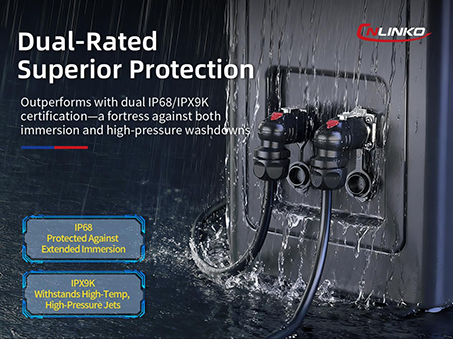
Key misconception: IPX9K does not automatically guarantee submersion protection. Unless an industrial connector product is also marked with "IP68/IPX9K," it cannot be guaranteed to resist prolonged submersion in still water. These two tests evaluate completely different physical forces—static pressure (submersion) versus dynamic pressure/thermal shock (high-pressure spray).
5. How to Choose the Right Protection Rating for Industrial Connectors?
Don't blindly pursue the highest rating. Higher IP ratings mean more complex structures and higher costs. For dry indoor environments, IP44 is sufficient—there's no need to chase IP67/IP68 unnecessarily.
Distinguish between "submersion" and "spray." IP68 excels at continuous submersion; IPX9K excels at high-temperature, high-pressure spray. They are not interchangeable.
Ask about test conditions when selecting IP68. The submersion depth and duration can vary dramatically between different industrial connector manufacturers. Always request clear test conditions and verification reports.
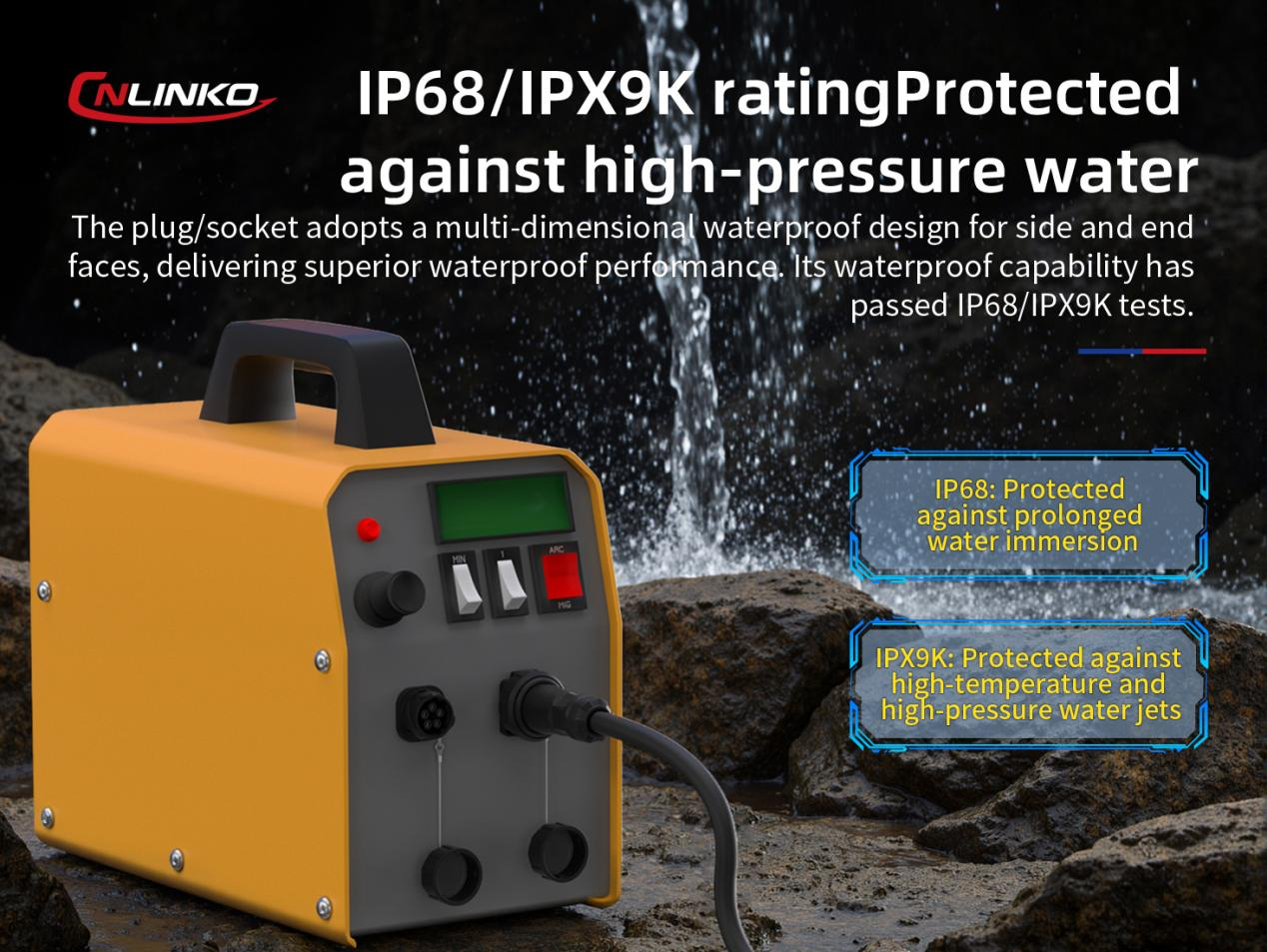
Need both submersion and spray protection? Choose combination certification. If equipment may be both submerged and require high-pressure cleaning, select products marked with both "IP68/IPX9K."
6. CNLINKO: Connector Solutions with IP68/IPX9K Dual Flagship Waterproofing
CNLINKO, a national-level specialized and new "Little Giant" enterprise, holds over 100 patents and its products are certified by UL, TUV, CQC, CE, and other international authorities. CNLINKO's LP, BD, YM, DH, DL, DK, and other series of industrial waterproof connectors all feature multi-layer waterproof barrier designs and pass both IP68 (submersion) and IPX9K (high-temperature, high-pressure spray) waterproof testing, providing enhanced protection for various water-exposed applications. For heavy-duty waterproofing scenarios such as photovoltaic/solar energy, unmanned vessels, outdoor LED lighting, food processing, and outdoor equipment, these connectors effectively prevent water ingress and resulting operational failures.
When selecting a waterproof rating, the key is matching the connector's waterproof performance to the actual working conditions. CNLINKO industrial waterproof connectors deliver excellent waterproof performance, offering high protection for various water-exposed environments and ensuring reliable, safe equipment operation.